
Chapter 10: Kagami
The teacher who has only one student cannot afford to lose her. The student who knows this has already learned the wrong lesson.

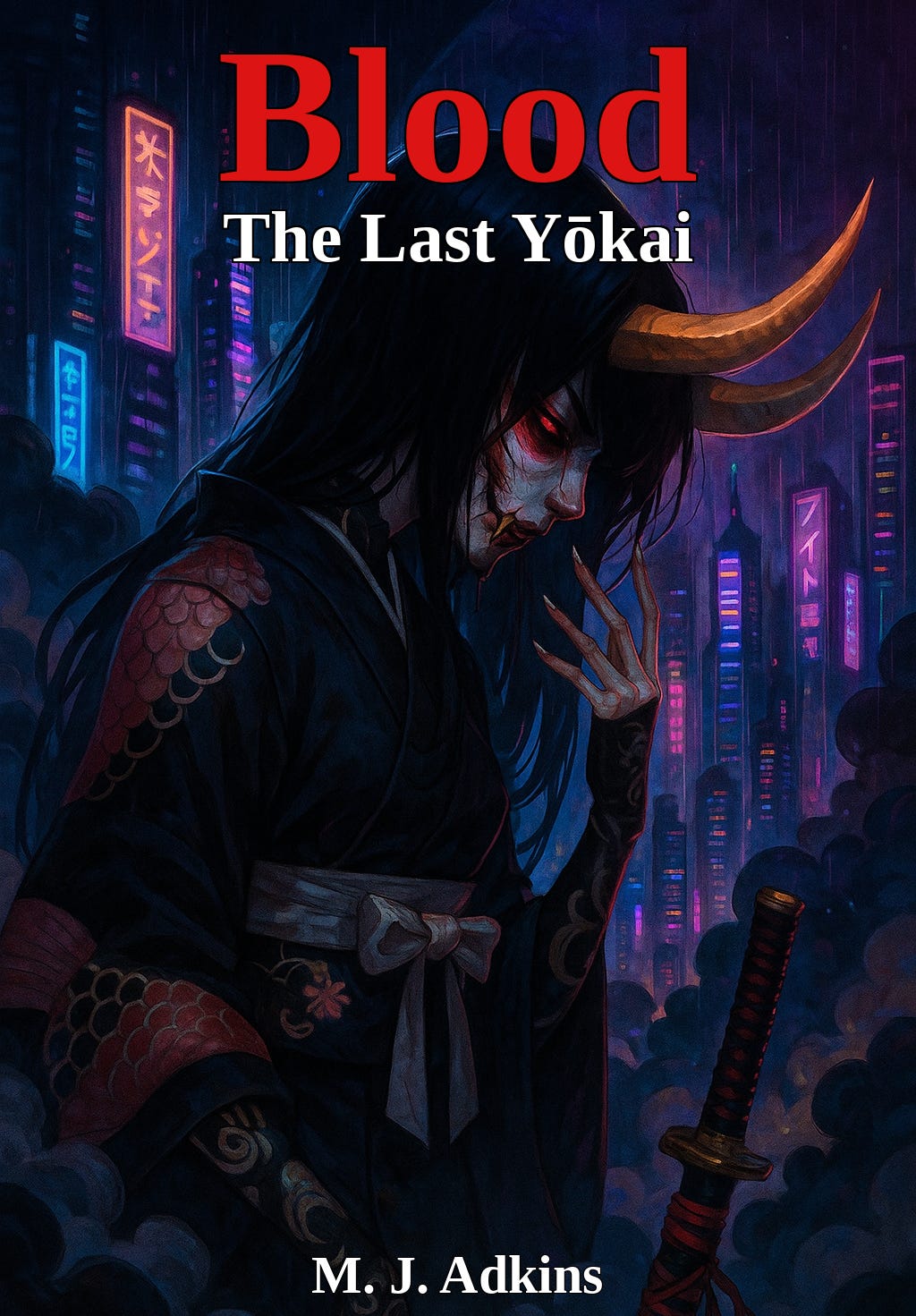
She heard Mika before she reached the building.
Not the footsteps—those were quiet enough, the calibration improving week by week in ways Kagami tracked without commenting on. The heartbeat. The specific rhythm of it, faster than baseline, the particular acceleration of someone who had been in a fight recently enough that the body hadn’t finished processing it. And underneath that, something she’d learned to read in the weeks since the conversion: the satisfaction frequency, the cellular hum of a body that had fed and was still carrying the warmth of it.
She had been sitting in the sublevel dark for four hours. She had found Mika’s last known location, found the alley, found what was in it, and come back here to wait because the alternative was moving through the city in the particular state she was in and she had eight centuries of evidence that moving while in that state produced outcomes she regretted.
She heard the service door. The footsteps on the stairs. The pause at the bottom, Mika reading the dark, finding her.
“You went to Fission,” Kagami said.
Not a question. Mika came the rest of the way down the stairs and into the space, and Kagami felt the fight-warmth coming off her more clearly now, close range, and something else underneath it. A burn along the forearm, already sealed. Energy katana. She noted this and set it aside.
“Yes,” Mika said.
Kagami said nothing. She had found, over eight hundred years, that silence was more precise than speech in certain situations. Speech gave the other person something to respond to, something to push against, an object they could navigate around. Silence was no object. It simply accumulated, and what accumulated in it was whatever the other person brought.
What Mika brought, after twelve seconds, was: “I fed. I survived. The hunt was clean.”
“The hunt left a body in an alley off Sakuragaoka. The third in that district in two weeks. There’s a pattern now.”
“The huntress already found me.”
The temperature in the room did not change. Kagami’s expression did not change.
“Tell me.”
Mika told it plainly, which Kagami had learned was her register under pressure—not deflection, not embellishment, the facts in sequence with the emotional content underneath them rather than inside them. The alley mouth. The woman. The energy katana. The fight, which had lasted longer than it should have lasted against a huntress of that experience, which was its own information. The wrist catch. The locked blades.
Kagami kept her face still while Mika described the locked blades.
Mika hesitated. “I felt something off her. A frequency. Below humanity. I don’t have a name for it. I thought you might.”
The frequency. The smell.
Kagami sat with this for a moment that she did not allow to become visible. She had been carrying this since the third exchange in Asuka’s apartment, since the smell that had no business being there, since the sublevel night when she’d finally stopped managing the information and let it mean what it meant. She had been carrying it through multiple weeks of conversion attempts and Kenji’s death and Mika’s training and the slow realization that the plan she’d been executing had been wrong in its target from the beginning.
She had the exact name for the frequency and the smell.
She was not going to give it.
“I don’t know what you felt,” Kagami’s lie came smoothly. “Combat produces artifacts. Adrenaline, the hunting sense running hot. You read signals that aren’t there.”
Mika looked at her. The look of someone who had just been told something untrue and was deciding whether to say so.
She decided not to.
Kagami noted this. It was exactly what she would have done.
“The huntress,” she said. “Describe her.”
Mika described her. The face, the cropped black hair, the build, the energy katana and its particular yellow edge, the way she moved—no wasted motion, no performance, the strikes arriving again and again until they got an answer. Kagami listened and felt the outline of Kiko assembling from the description, familiar from rooftops and alleys and the third exchange on Asuka’s apartment, the huntress she’d been running from and running toward for three years.
“You know her,” Mika said. It wasn’t a question.
“She’s the one I warned you about. The last of the NTSC.”
“She’s good.”
“She is.”
“I held her. Nearly—”
Kagami looked at her. “You also gave her a body to call in, a pattern to map, and confirmation that the conversion succeeded. She came looking for evidence of a newborn and found one who has been operating alone for two weeks.” She paused. “You accelerated her timeline considerably.”
The silence that followed had a different quality. Not Mika absorbing a correction—Mika preparing a position.
“I’m not a newborn,” she said. “I held a fourteen-kill hunter in a twelve-meter alley with a blade I taught myself to use.” Mika’s voice was even. The bluntness that was her register under pressure, sharpened. “Call me what the evidence supports.”
Kagami looked at her for a long moment.
“I’m going to tell you something,” she said, “and I need you to hear it as information rather than restriction. Can you do that?”
Mika waited.
“Every body is a coordinate. Three bodies in the same district, same method, same alley—that’s not a crime scene anymore, that’s a map with an X on it. The huntress doesn’t need to find us. She needs to follow the map we’re drawing for her.” Kagami kept her voice level. “You are good and you will be better. That is not the question. The question is whether you will be better faster than she closes the distance, and tonight you shortened that distance considerably.”
“So don’t leave bodies?”
“We don’t kill.”
“You’ve killed,” Mika said. “Two weeks ago. The outskirts beyond the industrial district.”
“One. Controlled. In a location I chose because it would take days to find and would not establish a pattern.” Kagami paused. “And because I was teaching you what a clean scene looks like. Not modeling what I intended you to replicate unsupervised.”
“I’m not unsupervised. I supervised myself.”
There it was. The thing underneath the argument, the actual position: Mika had decided that Kagami’s authority over her had a limit, and had been operating past that limit for two weeks, and was now defending the operating rather than the limit. Which meant the limit was the real conversation.
Kagami knew this was coming. She had been watching it develop the way you watched weather develop—the pressure system building, the temperature differential, the inevitable. She had not known how to prevent it because she was not certain it should be prevented. What she had made was not a student who would stay a student. She had always known that.
What she had not anticipated was how quickly.
“You were made three months ago,” Kagami said. “I was made eight hundred years ago. The gap between us is not a matter of opinion.”
“The gap between us is closing,” Mika said. “You know that. I can sense you knowing it.”
Silence.
Kagami looked at her—this woman she had converted in an apartment she had invaded, had held through the worst of it, had taught everything she knew how to teach and some things she hadn’t known she knew until the teaching produced them. Who had her wakizashi, which Kagami had not mentioned, because mentioning it would require acknowledging that she had noticed and done nothing, and she wasn’t quite ready to examine why.
“Then we have to address the huntress. The kills stop or we deal with her first, not because I’m forbidding anything, but because they are drawing her to us faster than we can afford.”
Mika looked at her for a long moment.
“And if I disagree about the killings?”
“Then you disagree with it,” Kagami said. “And I will note the disagreement and ask you to trust my assessment of Kiko’s capabilities, which is based on three years of direct engagement, and your own assessment of what it felt like to hold her for two seconds.” She paused. “You held her. You didn’t stop her. There’s a difference.”
Something moved across Mika’s face.
“The kills won’t stop,” she said finally.
“Then the huntress becomes our immediate problem,” Kagami said. “Not yours. Mine. I have three years of engagement with her that you don’t have. Let me work the problem.” She held Mika’s eyes. “Can you give me that?”
A long moment. “How long?”
“Enough time to do it correctly.”
Mika nodded, moved to her corner of the sublevel, the space she’d made hers over three months—the blankets, the few things she’d accumulated, the half-marathon medal she’d taken from her apartment on the last night she’d been there and never mentioned and Kagami had never asked about. She lay down with her back to the room.
Kagami watched her for a while. The breathing evening out. The fight-warmth fading as the body settled. The heartbeat finding its new resting rhythm, the one that wasn’t quite human, that she’d been listening to for three months and had stopped finding strange.
She waited until she was certain Mika was under.
Then she sat in the dark with what she knew.
The frequency.
She had told Mika she didn’t know what it was. She had told her combat produced artifacts, that the hunting sense ran hot under pressure and read signals that weren’t there. Both statements were technically defensible. Neither was true in any sense that mattered.
She knew what the frequency was. She had known since the sublevel night when she’d finally let herself think about it—the smell that wasn’t supposed to be there, the eight centuries of recognition, the specific quality of something she had been looking for since Hana and had not expected to find on a huntress who was trying to kill her.
Kiko was not entirely human. Kiko did not know she was not entirely human.
And now Mika had felt it too, from close range, through locked blades and the particular intimacy of a fight that goes past the first exchange and into the place where bodies start reading each other rather than just responding. Mika had come back with the frequency and given it to Kagami and Kagami had taken it and said nothing.
She sat with the weight of that.
Mika had felt the frequency. Mika had come back and handed it to her. And if Kagami told her what it meant, what she intended to do about it, Mika would have opinions, and Mika’s opinions on the huntress’s survival had been clearly established tonight in a twelve-meter alley.
Kagami needed the approach. She needed Kiko alive and still long enough to hear something that would require her to dismantle everything she thought she knew about herself. That was not a conversation that survived Mika knowing it was planned.
Mika couldn’t know. Not yet. Not until Kagami understood what Kiko would do with the truth.
She had been the last for a very long time. She had been carrying the knowledge of what Kiko was alone since the sublevel night, and there was something in the carrying of it alone that was, she tried to find the honest word for it. Hers. The knowledge was hers. The recognition, the eight centuries of looking and finally finding, the particular quality of a thing you have been moving toward for so long that arriving feels like something you need a moment alone with before you share it.
She recognized this as insufficient justification. She noted it anyway.
Outside, Neo-Tokyo continued its three AM rhythms. The hover-rails moving on their invisible currents. The huntress was reading a scene in an alley and adding it to what she already knew, and the distance between them was shorter tonight than it had been yesterday.
Kagami looked at Mika’s sleeping shape. The half-marathon medal catching the dim light from the gap in the ceiling, the one she’d never asked about.
She had to approach Kiko. She had known this since the sublevel night and had been finding reasons to defer it, operational reasons, good reasons, and the reasons had run out tonight. Mika had shortened the distance. The hunter was mapping. The window was closing.
She would approach her. Not tonight—tonight she needed to think through the how of it, the geometry of approaching a woman who had put a blade through her knee and spent three years hunting her, and asking that woman to stand still and listen to something that would require her to dismantle everything she thought she knew about herself.
But soon. Before the hunter finished the map.
She sat in the dark a little longer. Let herself have the moment. The knowledge that was still, for a few more hours, entirely hers.
Then she began to plan.
*** © *** 2026 *** Michael Joseph Adkins ***