
Chapter 5: Kiko
The huntress who studies only her prey never thinks to ask what the prey has learned about her.

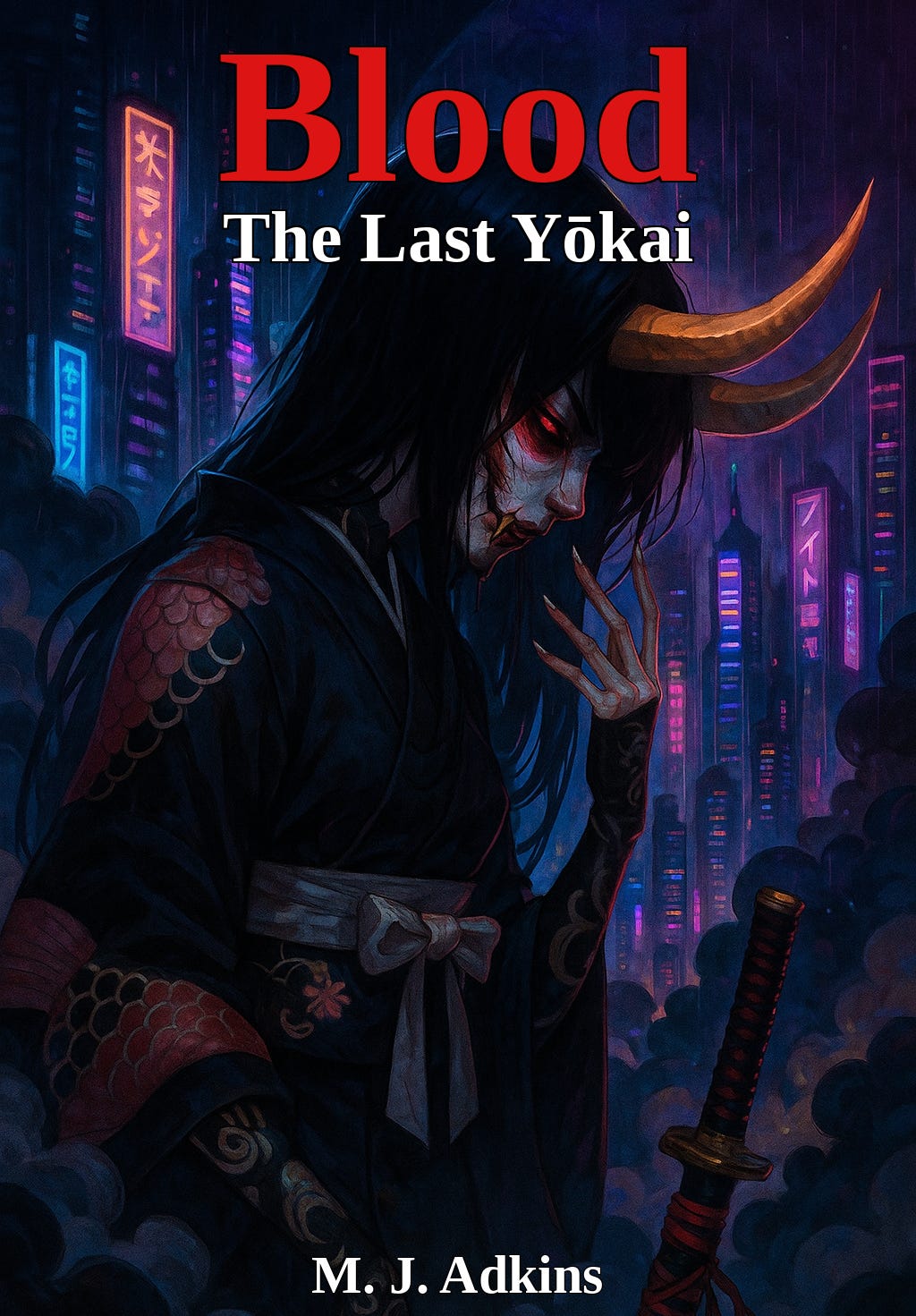
Four days since Kenji.
The safehouse smelled of stale coffee and greeted them with familiar stillness. Equipment humming. Blackout film over the windows. The mattress in the corner that she never used enough.
Kiko moved to the window and lit a cigarette.
Shin pulled up the map of Neo-Tokyo on the main holoscreen. Seven red pins clustered in Shinjuku Ward, all within a rough ten-block radius. Entertainment district. High foot traffic. Easy cover. He’d been staring at the same cluster for four days and it still wasn’t giving him anything new.
“Same hunting ground every time,” he said. “She scouts in the crowd. Follows them home or lures them. Two of the victims left clubs alone. Two were seen leaving with a woman matching her description.” He leaned back. “Smart about camera coverage too. Sticks to the gaps.”
She studied the pins without moving from the window.
“When she tries again it’ll be there.” Shin crossed his arms. “We could monitor the clubs. Increase presence.”
She shook her head slightly.
He sighed. “Half a million people moving through that district every night. Yeah.” He settled into his chair. “We wait. She makes a mistake, we move fast.”
It wasn’t a good plan. It was the only plan.
The scanner ran its usual chatter. Domestic disturbance in Neo-Shibuya. Traffic incident near the port. Shin’s hand stayed near the controls.
She took a long drag. Outside, the corporate towers pulsed against the haze. The same view every night. She’d stopped seeing it years ago.
“You’re not worried,” Shin said.
Not a question. She exhaled smoke into the night.
“Never am, I can’t afford to be. Kenji lasted hours,” she said. “Untrained. No technique. It lasted seconds.”
“Kenji isn’t Kagami.”
“No. Kagami runs when she’s losing.” She tapped ash from the cigarette. “She won’t run forever.”
Shin was quiet for a moment. She could feel him working up to something—the particular quality of his silence when he was choosing words. She’d learned it over two decades of close quarters. She waited him out.
“Here’s some intel you don’t know,” he said finally. “Before the Commission got down to just us—she killed three of our people.”
She knew this. It was in the file, old news. She said nothing, let him continue.
“Asato she drained. Quick. Probably didn’t see it coming.” He pulled off his glasses, turned them in his hands. “Daishi went down in direct confrontation. He was good. One of the best we had.” He paused. “She killed him in under two minutes.”
Kiko watched the highrises.
“And then there was Yui.”
Something in his voice shifted. She turned from the window.
Shin wasn’t looking at her. He was looking at the map, at the red pins, at nothing in particular. The glasses still in his hands. She had been wrong, never heard anything about Yui.
“What happened to Yui?” she asked.
He set the glasses down on the desk. “Kagami merged with her. Wore her skin. Her voice, her mannerisms, her access codes.” He stopped. Collected something. “We didn’t know for months. Yui kept showing up to briefings, filing reports, drinking the same terrible tea she always drank.” His jaw tightened. “By the time we understood it wasn’t her, Kagami had walked out of every secured location we had. Read everything we’d built. Decades of operational data.”
The scanner murmured in the background. Neither of them moved.
“How long did it take you to figure it out?” Kiko asked.
“Eight months.” He finally looked at her. “And I worked alongside Yui every day. I knew her. I thought I knew her.” He picked the glasses back up. Put them on. “That’s what I’m telling you. It wasn’t a fight she won. It was a complete deception. She didn’t just overpower Yui. She became her. And we handed her everything.”
Kiko turned back to the window. Drew on the cigarette.
“I’m not Yui,” she said.
“I know that.”
“And she’s not going to get close enough to—”
“Kiko.” His voice was quiet. Not sharp. The tone he used when he needed her to actually hear him. “I’m not saying you’ll make the same mistake. I’m saying she’s been doing this for a very long time. Longer than any of us. She’s patient in ways we don’t have a framework for. And she just proved the conversion works.” He leaned forward, elbows on the desk. “That changes things. She’s not desperate anymore. She’s building something. And she’s smart enough to know you’re the last thing standing between her and that.”
The cigarette had burned low. She dropped it and ground it out on the windowsill.
“The other hunters in the NTSC,” she said. “What happened to them after the decommissioning?”
Shin looked at her for a long moment. Then he leaned back and rubbed his face. Something moved behind his eyes, not evasion exactly. The look of a man deciding how much of a thing to say.
“That’s—” he started.
“Shin.”
He opened his mouth. Closed it. Looked at the map instead of her. “They were—”
The scanner erupted.
“Multiple 10-38s, Shinjuku Ward, Kabukicho, Kuyakusho-Dori Avenue vicinity. Multiple callers reporting an adult male wandering the street, apparent blood loss, unresponsive to bystanders.” A pause. “Caller describes heavy bleeding from the neck. Male is ambulatory but disoriented.” Another pause. “Third caller now. Same male, one block east, heading toward the Yasukuni Avenue intersection. He’s on his feet but not responding.”
Shin was already on his feet.
She was already at the door.
She didn’t look back at him. But she noted the way his answer had stopped, the particular shape of what he hadn’t said, and stored it. The same way she stored everything she wasn’t ready to open and walked out into the dark.
They found him four blocks from the first call.
He was walking—that was the thing, still walking, moving through the Kabukicho crowd with the slow deliberate steps of a man who had forgotten where he was going but not how to move his feet. Mid-fifties, salary worker, shirt collar dark and wet. The puncture wounds were on the left side of his neck, two of them, clean spacing. Blood had soaked the shoulder of his jacket and run down his arm and dripped from his fingers, and he was leaving a trail of it across the pavement and nobody in Kabukicho at two in the morning had stopped him, not because they were cruel but because in that district a bleeding man on foot didn’t automatically mean what it meant anywhere else. Three people had called it in. The rest had stepped around him.
Shin caught his arm gently, talked him down to the curb. The man sat without resistance, looked at the neon signs above Toa Road with the particular blankness of someone whose body had continued without them.
Kiko stood back and looked at the trail he’d left.
It started in the alley behind the mid-rise on the east side—she traced it backward, the drops getting closer together, the spacing of a man who’d been standing still before he started walking. The alley fed into a service corridor between two buildings, camera coverage nonexistent, a gap she’d have spotted on the district map if she’d been looking for it. A dead zone between the hostess club on the corner and the bubble tea shop backing up to it, invisible from the main street and invisible from the parallel alley.
She walked the trail back to where it started. A smear on the wall at shoulder height. A single drop on the lip of a drainage grate. That was where Kagami had taken him—standing, not kneeling, which meant she’d moved fast enough that he hadn’t had time to react, hadn’t had time to fall.
“No conversion attempt,” Shin called from the link. “Clean punctures. No secondary markers. She fed and walked away. The guy doesn’t even know what happened in the past twenty minutes.”
Kiko looked at the dead zone. Then back at the crowd on Toa Road—the hostess club touts in their suits, the groups of salarymen moving between bars, the bodies pressing together in the familiar looseness of people unafraid. If you stood at the alley mouth you could watch the whole strip. You could read the crowd. You could choose.
“She’s been working this district for months,” Kiko said. “Every gap in coverage, every blind spot. She knows this street the way she knows a hunting ground.”
“Because it is one,” Shin replied.
“Because she made it one.” Kiko turned from the alley. “She didn’t find these gaps. She mapped them.” She looked at the trail on the pavement, the drops leading away from the dead zone toward the neon intersection where the first caller had spotted him. “And she left him walking.”
“Medtech is here, crowd is gathering,” Shin said. “I think we’ve got all we’re going to get.”
“Why leave him alive?” Kiko asked, more to herself than to Shin.
“I was going to ask you that same question.” He sighed. “She’s been draining people for years.”
“Has she though, or were the others?”
The link went silent for a long moment before Shin spoke.
“So what do we do?”
She was already moving back towards the car. “We start hunting and stop waiting.”
She dropped Shin at the safehouse and kept the car.
She drove the elevated routes first, then down into the grid. Not going anywhere. Just moving, the way thinking sometimes needed the body occupied. Neo-Tokyo scrolled past—the neon, the towers, the holograms strobing across wet asphalt.
Shin’s voice still in her head. She became her. And we handed her everything.
Yui. Eight months. The same terrible tea.
She knew some of the operational history. Yui was before her time, but she was better than Yui, and faster than Daishi. She’d already survived fourteen direct confrontations where the others hadn’t survived one. She examined the belief now, sitting in moving traffic, and found it solid.
She also thought about the blood trail on Toa Road. The dead zone in the camera coverage. The gap she’d have spotted on the district map if she’d been looking. She hadn’t been looking because she’d been mapping Kagami’s movements, her patterns, her candidate selection. Building a profile.
Kagami had been doing the same thing in the same district for months, and Kiko hadn’t thought to map the gaps.
She sat with the question Shin hadn’t answered. They were— and then the scanner, and his face before it, the profound shape of what he’d been deciding. She’d worked alongside him long enough to know the difference between a man who didn’t know something and a man who knew it and was weighing what saying it out loud would cost.
She was beginning to run a sizable collection of unlabeled files.
What Shin was actually afraid of, she understood now, wasn’t a fight. He knew her well enough for that. What he was afraid of was the version of this that didn’t look like a fight. Yui had been good. Yui hadn’t seen it coming because it hadn’t announced itself as something to see.
She turned the car and drove back.
The safehouse was dark when she returned. Shin had left a covered plate on the desk and gone to sleep, which was the closest he ever came to insisting without saying it out loud. She stood over the plate for a moment, then moved to the mattress and lay down, boots still on, katana within reach.
Her eyes closed. The safehouse hummed around her—equipment cycling, the scanner’s low murmur, city noise bleeding through the blackout film.
Shallow sleep came the way it always did. Not rest. Suspension.
Somewhere in it, she became aware of her right hand. Not pain. Not quite sensation. The absence of something, the way a sound registers only after it stops. Her sword hand lying open against the mattress, doing nothing. The katana a foot away, powered down, silent.
She had felt it before. She had never felt it when the katana was powered down.
She filed it without a label. Didn’t open her eyes.
She let the city’s hum pull her back under. It sounded different than it used to.
*** © *** 2025 *** Michael Joseph Adkins ***