
Chapter 7: A New Hunger
Her old body: a drop of dew heavy upon the leaf’s edge.

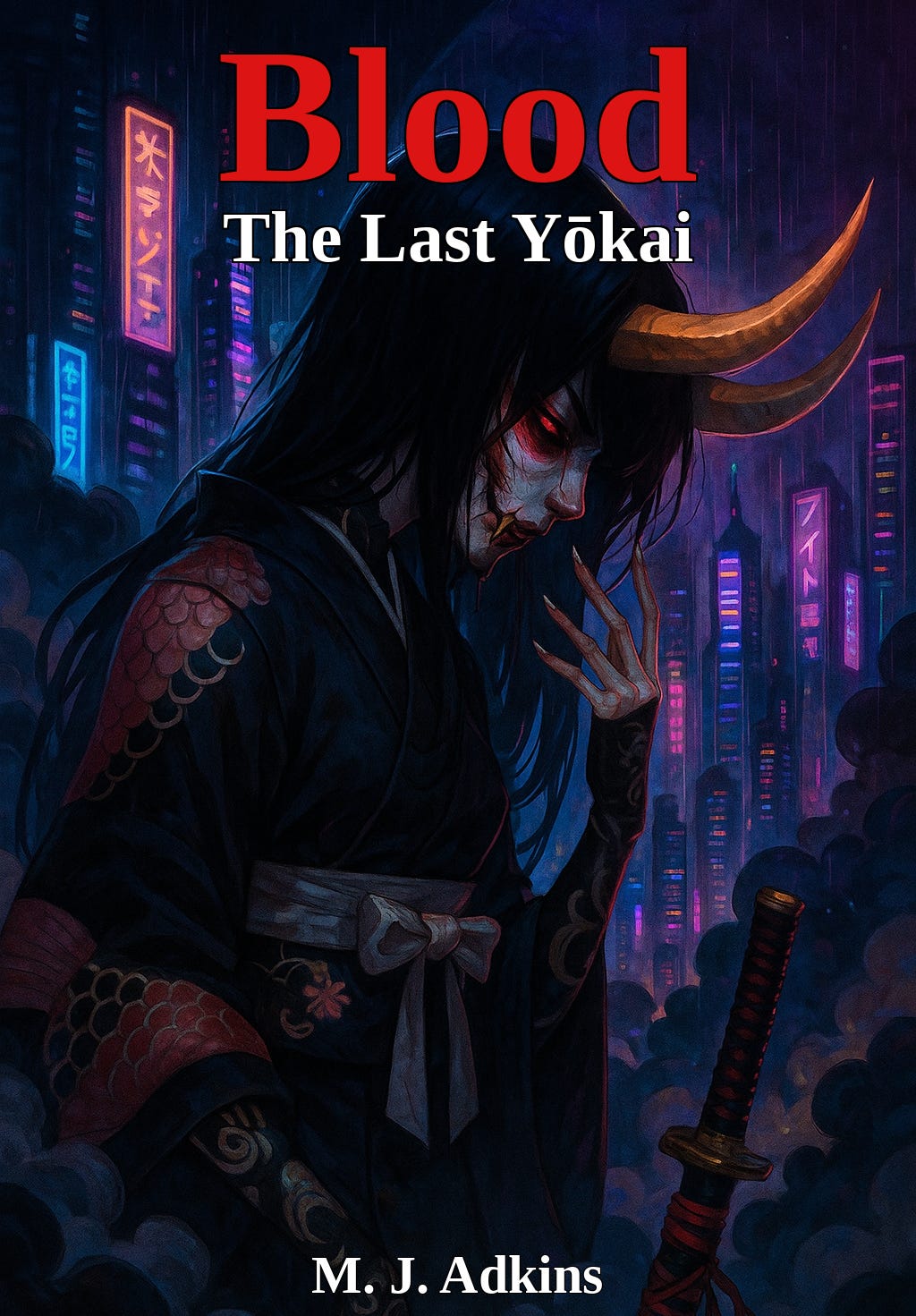
Cold.
That was the first thing. Not pain, not confusion. Cold. The specific deep cold that sunk and settled down into marrow. Her own body, running wrong.
She opened her eyes.
Kagami was crouched beside the couch, watching her with the focused attention of someone examining an instrument panel. Taking readings. Looking for failure points.
Mika sat up slowly. The apartment was spinning. Something black came up from her throat and she turned her head and let it go.
This morning was a different century.
“How do you feel,” Kagami said. Not a question exactly. The tone of someone beginning an assessment.
Mika took inventory. Cold. Present. The senses opening in a way that had no comparison—the apartment was the same apartment and entirely different, every surface giving off information she hadn’t been able to read before. The smell of her own blood. The residue of whatever had moved through her. And underneath it, something that wasn’t hunger the way she’d ever understood hunger.
“Freezing.” That was the first word that came to mind.
“What else?” Kagami pressed gently.
“Burning,” she said. “It’s not like being hungry. It’s more like—” She stopped. She didn’t have the word for it. “Like something’s missing that was always there and I didn’t know it was there until now.”
Kagami tilted her head slightly. Still reading.
“What did you put in me?”
“Everything I had left to give.”
That wasn’t the answer to the question she’d asked. She looked at Kagami’s face, the bone-white skin, the proportions that had read as extraordinary modification two days ago in a gym under fluorescent lights. She thought about the hyperweave comment. Takeda Industries level work. The professional appreciation she’d felt, admiring high-tech mods.
It is real, Kagami had said. Taking it as a joke about quality.
The pieces had a shape now.
“You’re actually yōkai,” Mika said.
“Yes.”
“And you made me—”
“Yes.”
She sat with this for a moment. The burning in her stomach was sharpening, finding an edge. She looked at her hands. The veins visible beneath the skin had a darkness to them that hadn’t been there yesterday, a shadow running through the architecture of her.
“My parents are going to file a missing person report,” she said.
Kagami said nothing.
“My mother calls every Sunday. If I don’t pick up she calls my neighbor to go check on me. She has a key.” Mika looked at the apartment. The blood. “She cannot come here.”
“No.”
“So I need to call her. Tonight. Before—”
“You can’t tell her anything.”
“I’m telling you she will come here—”
“And I’m telling you that you cannot speak to her.” Kagami’s voice was quiet, without cruelty, the tone of someone delivering a structural fact. “Not tonight, not this week. What she hears in your voice will frighten her. What you might do if she comes here—” She stopped. “You’re not stable yet. You don’t have control. Anyone who matters to you is not safe near you right now.”
Mika understood this. She hated that she understood it.
“When?” she asked.
“I don’t know.”
“Will I ever be able to—”
“My maker, Hana, never allowed me the chance.” Kagami’s eyes held hers. “That’s the truth. I don’t have a precedent for this. I’m the last of the original yōkai. You’re the first of whatever comes next. I can tell you what I learned, which is not everything, and we will find out together what I don’t know.”
The honesty of it was somehow worse than a lie would have been.
Mika put her face in her hands. Not crying—she couldn’t tell if she could cry anymore, the mechanism felt different, uncertain. Just the pressure of her palms against her eyes, the old childhood gesture of making the room go away for a moment.
Her mother’s voice on Sunday mornings. The specific way she said Mika-chan when she answered, like the name itself was good news.
Eight weeks to the half-marathon. She’d told her mother about the training, the long runs on Saturday mornings, how her knee had been holding up. Her mother had asked if she was eating enough. She’d said yes and had actually been eating enough, which felt like a recent achievement worth noting.
She was never going to run that race.
She put her hands down.
“You stalked me,” she said. “You watched my apartment. You looked up my name on the building directory.” The facts arriving in sequence, everything clarifying. “You chose me before you spoke to me. Didn’t you?”
“Yes.”
“And everything at the gym—”
“Was deliberate. Yes.”
“The conversation. The invitation.” The burning in her stomach sharpened again and she breathed through it. “Did any of it mean anything to you or was I just the best candidate you’d found this week? Out of everyone in this city? Me?”
Kagami was quiet for a moment. The quality of the silence was different from evasion.
“You weren’t just a candidate,” she said finally. “That’s true and it doesn’t change what I did.”
“No,” Mika agreed. “It doesn’t.”
She stood. Her legs held, steadier than they should have been given what her body had been through. She walked to the window. The street below was quiet at this hour, a hovercar drifting past trailing an advertisement for something she didn’t read. The city continuing without her.
“My whole life I’ve lived in this city,” she said. “Same ward I grew up in. My parents are twenty minutes from here. My mother walks past my building on the way to the market on Thursdays.” She pressed two fingers to the glass. Cold. She couldn’t feel the temperature differential anymore, inside and outside both the same to her now. “I always thought I’d be here when they got old. That I’d be the one who showed up.”
Kagami said nothing. There was nothing to say.
“You took that from me.” Not accusation. Just accounting. “Whatever else this is, whatever you gave me, you took that.”
“Yes.”
The confirmation landed the way she’d needed it to. Not softened. Not argued with. Just acknowledged.
It didn’t help.
Mika turned from the window. Looked at the apartment. The black substance drying into the floor, the gym bag by the door she’d packed this morning for a life that no longer existed. She walked to the kitchen because she needed to move and there was nowhere to go. She stood at the sink. Turned the tap on. Turned it off. The hunger was sharpening and she couldn’t eat and she couldn’t call anyone and she couldn’t leave and she was twenty minutes from her parents’ apartment in a city of sixty million people and she had never been more alone in it.
She picked up a glass from the drying rack and threw it at Kagami. The glass passed her harmlessly and shattered against the wall.
The sound of it was satisfying for approximately one second.
She stood in the kitchen looking at the pieces and felt the rage cycling back into something worse than rage—the specific grief of a door that has closed and will not open again regardless of how long you stand in front of it. She had stood in front of doors like that before. A job she’d wanted at nineteen. A relationship at twenty-four that she’d believed in longer than the evidence warranted. She knew the texture of irreversibility.
This was that texture but the door was her entire life.
“You heartless bitch,” she didn’t shout it. The words came out angular anyway.
She became aware that she was crying. Or trying to, something was happening in her chest and behind her eyes that had the structure of crying without the mechanism. Whatever the conversion had rewritten had rewritten that too, apparently. She couldn’t even do this correctly.
“I hate you,” she said. Not loudly. Just true.
“I know you do. I hated Hana too, for a long time.” Kagami said from in front of the couch.
“No, I want you to understand that. Not as information. I want you to actually feel it.” Mika paused, looked directly into Kagami’s eyes. “I. Fucking. Hate. You.”
Kagami said nothing. Mika looked at her—the ancient face, the managed proportions, centuries of doing this dressed up as consideration, and understood that Kagami probably could feel it, which was somehow worse than if she couldn’t. Worse because it meant the thing that had been done to her had been done knowingly, by someone capable of knowing, and done anyway.
The hunger flared. Sharp. Specific. She pressed her hand to her stomach.
“How long before it gets dangerous,” she said.
“An hour. Maybe less.”
She laughed, short and without warmth. An hour. She’d been awake for twenty minutes and already the clock was running. Already survival was crowding out everything else, the hunger asserting its priority over grief, over rage, over the glass in pieces on the apartment floor.
Mika understood in this moment, a clarity born to her unlike any other, hunger lied beneath all of the ugliest transactions.
“Show me what I am now. All of it. Don’t manage what I can handle.”
The hunger had become its own kind of weather by the time they reached the industrial district—a pressure system moving through her, tightening. She could smell the city differently now, layers she’d never had access to before, and underneath all of it that warmer signal, the one that pulled at something she didn’t have a name for yet.
Kagami moved through the empty streets with the ease of long practice. Mika followed and tried to understand what her body was doing. The strength was the most disorienting part—she kept calibrating wrong, her foot coming down harder than intended, a door handle bending slightly under a grip she’d meant to be light.
“Stop adjusting,” Kagami said, without looking back. “You’re fighting yourself. The calibration comes from use, not from caution.”
“Easy for you to say. You’ve had centuries.”
“Do you think it was always easy?” Kagami stopped walking, placed a hand on Mika’s shoulder.
They pressed against a wall at the edge of an alley mouth. Kagami gestured for silence and Mika found that silence was different now too—she could hear the city’s layers separated out, the distant bass of clubs, the electromagnetic frequency of the hover-rail two kilometers away, and closer, footsteps. Steady. Unhurried.
A man came into view at the far end of the street. Night-shift worker by the look of him, thermos in hand, moving with the particular economy of someone who had done this route so many times he’d stopped seeing it.
The hunger responded immediately.
It wasn’t like seeing food when you were hungry. It was more like a tuning fork finding its frequency—her body recognizing something it was built to need and reorganizing itself toward it without consulting her. Her vision sharpened around him. The pulse at his throat visible from thirty meters.
“Easy,” Kagami said quietly. Her hand on Mika’s arm. “This is the first thing you learn. The hunger will always move faster than your mind. Your job is to close the gap. We don’t kill.”
“How?”
“You already know how. You’ve been doing it your whole life. Every time you were frightened, every time you were furious, you know how to hold something until you can use it properly.” Kagami’s grip tightened briefly. “This is the same.”
The man drew closer. Mika held herself still and breathed through the wanting and watched Kagami move.
She was fast in a way that didn’t look like speed—more like the space between one position and another simply didn’t exist. The man had no time to register what was happening. Hand over his mouth, arm around his chest, drawn backward into shadow without a sound. Kagami caught his eyes and held them and something passed between them that Mika felt from ten feet away, a pressure, a will imposed. The man’s struggling ceased. Not unconscious, present, but compliant, the fear still there but no longer in control of his body.
Kagami fed quickly. There was nothing theatrical about it. Clinical was the wrong word—it was practiced, the way any motion was practiced over sufficient time, the body knowing exactly what was needed and taking precisely that.
She withdrew. Pressed two fingers to the wound with a focus Mika recognized from the conversion, something passing back out of her, some small closing. The mark diminished. The man slumped against the wall, breathing, already forgetting.
Kagami turned to her. “We don’t kill.”
The man stumbled off as if nothing had happened.
“What did you do at the end? With your fingers.”
“Sealed the wound. Closed the memory.” She paused. “I’ll teach you that after you’ve fed. One thing at a time.”
They waited. Mika stood in the shadow and listened to the industrial district’s particular silence and tried to hold herself steady against the hunger, which had watched what Kagami just did and wanted, specifically and insistently, what it had seen.
The second man came ten minutes later. Younger. Delivery jacket, earbuds in, his attention on the holophone in his hand. He walked with the loose ease of someone who had decided this route was safe a long time ago and hadn’t revisited the decision.
“Now,” Kagami said.
Mika moved.
She was behind him before she’d processed the decision to move. Her hand over his mouth—she felt him flinch, felt the breath of surprise against her palm, felt his pulse accelerate under her arm where it crossed his chest. She pulled him backward. He was solid, heavier than he looked, and she lifted him without effort, which was its own horror, the ease of it, the way the strength didn’t ask her permission.
“Eyes,” Kagami said quietly from somewhere behind her.
She turned him. Met his gaze.
He was frightened. Deeply frightened, the kind that bypasses thought and goes straight to the animal layer. Brown eyes, wide, the pupils blown out with adrenaline. A young man who had been walking home listening to music.
Be still, she thought. Not aloud. The pressure formed somewhere behind her eyes, extending outward, and she watched him feel it—watched the fear not disappear but recede, pushed back by something she was doing that she didn’t entirely understand yet. His struggles slowed. His breathing steadied.
She was doing this to a person. She was aware of that. She held the awareness at the same time she held him, and she did it anyway, because the hunger had found its frequency and she didn’t have the architecture yet to refuse it.
She bit.
The blood was—
There wasn’t a comparison. The hunger had been a sound and now the sound stopped and in the silence something warm and total moved through her, not just the body, the cells, the cold places where the conversion had spent itself—she felt the replenishment reaching further than the physical, as though what she’d been given and what she was taking were the same substance and she’d been incomplete without it and hadn’t known.
She drank.
“Mika.”
She heard Kagami. Registered the word.
“Mika. Slow down.”
The man’s heartbeat was loud against her mouth. Strong. Still strong. Still so much there.
“Mika—”
She felt Kagami’s hands on her shoulders. She reached back and shoved, not thinking, not deciding, the hunger deciding for her, and heard the impact against the wall and didn’t look. The heartbeat was slowing. She could feel it slowing and it didn’t matter, the slowing just meant less time, meant she should take more now while there was still more to take.
She bit deeper.
Kagami hit her with her full weight.
The shock of it broke the contact—she was moving through the air, she was in the wall, brick giving slightly under the impact, and she was on her feet with her fangs bared before she’d landed. Rage, pure and structural, something she hadn’t chosen. She looked at Kagami and for one second Kagami was between her and the thing she needed and that was the only fact that existed.
Then she saw Kagami’s face.
The human surface was gone. What was underneath it was something Mika had no category for, the jaw displaced, the teeth multiplied and reorganized, the proportions of the face no longer managing toward human at all. Centuries visible all at once. Not a threat display. A reminder.
Mika looked at the man on the ground.
He wasn’t moving.
She listened for the heartbeat the way she’d already learned to listen without knowing she was learning it.
Nothing.
The rage left. She didn’t chase it. She stood in the alley and looked at the man on the ground and felt the warmth of his blood still moving through her and understood, very clearly and without the buffer of shock, what she had done.
She had killed him. She had felt his heartbeat slow and she had taken more anyway. She had shoved Kagami into a wall to keep taking. She had done all of this and some part of her had been satisfied by it and was still satisfied by it, the hunger quiet now in a way it hadn’t been since she’d woken on the couch.
She thought about her mother, forty minutes from here, sleeping.
She thought about the man’s brown eyes when she’d held them.
Kagami’s face was returning to its managed shape, the terrible geometry receding. She was watching Mika the way she’d watched her on the couch—reading the instrument panel. Looking for failure points.
“Say it,” Mika said.
“You lost control. The bloodlust took over when the hunger was partially satisfied, which is the most dangerous window. The partial satisfaction feels like evidence that you can take more.” Kagami’s voice was steady. Clinical. “It isn’t evidence. It’s the hunger arguing for itself”
Mika crouched down. She didn’t know why, some instinct, some need to be at his level rather than standing over him. He was young. Younger than she’d registered in the operational calculus of alone, distracted, available. There was a callus on his right hand from what might have been a steering wheel. His holophone had skittered under the dumpster when she’d grabbed him and the screen was still lit, music still playing, the playlist ending its current song and moving to the next one without him.
She had felt his heartbeat stop.
She had not stopped.
“The hunger,” she said. “When it was happening. I could hear you. I knew you were there and I didn’t care.”
“That’s bloodlust,” Kagami said.
She looked up at Kagami. “Is that what I am now? Something that doesn’t care?”
Kagami was quiet for a moment, and in the quiet Mika heard the thing she was actually asking, which was not a question about taxonomy.
“No,” Kagami said finally. “You care now. You’re here, crouching next to him, asking the question. The bloodlust is a state, not a character.” She paused. “But it’s a state you’ll enter again, until the control is built. And in that state you won’t care. And afterward you will.” She looked at the body. “You’ll have to learn to carry both of those things at once.”
Mika stood. Her hands were clean, some efficiency of the feeding, some closing of the transaction. She looked at them anyway.
She thought about the half-marathon. The long Saturday runs. The way the city looked from the elevated path along the river before the rest of the world was awake, the specific orange-pink light of early morning, the towers just beginning to catch the day. She’d been running that route for two years. She’d been planning to run it one more time before the race, the whole course, to know she had it in her.
She would never run that route again. Not as what she’d been.
She thought about her mother calling on Sunday.
She thought about the thing she’d felt when the blood hit—that replenishment, that completion, the hunger going quiet. She had killed someone and felt completed by it and the completion was still there, present and physical and real, underneath the horror of looking at the man on the ground.
That was the thing she was going to have to carry.
Not the guilt alone. The guilt and the satisfaction together, inseparable, the same event producing both at once and her unable to claim one without the other. She didn‘t know if she could hold that. She didn’t know what it would do to her over time, if it would erode something or if it would simply become her ground floor, the weight that was just weight after long enough.
She looked at Kagami.
*** © *** 2026 *** Michael Joseph Adkins ***