
Composure
Big thanks to Tales From Sphyra (@ctfinney) for the image prompt.

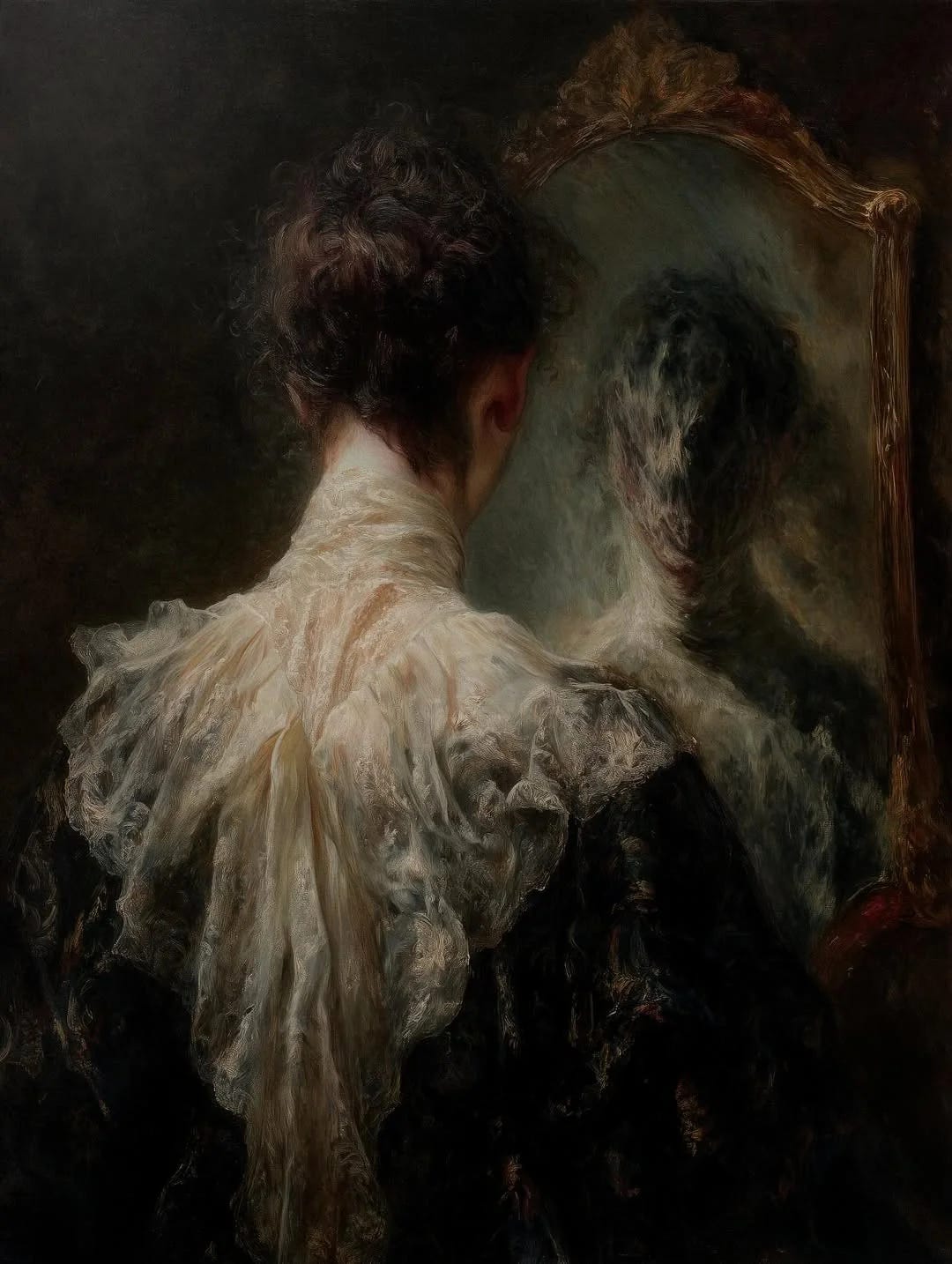
The first time Mother brought her into the dressing room for instruction, Cordelia was seven, and the lamps had been lit early because the November afternoon had gone dark by four.
Mother set her in front of the cheval glass and stood behind her with both hands resting on Cordelia’s shoulders. The hands were warm through the wool of Cordelia’s pinafore. In the glass Cordelia could see herself, very small, and her mother above her, very tall, and behind them both the room with its papered walls and its closed door.
“Stand the way I showed you in the morning room,” Mother said.
Cordelia straightened. She had been practicing in the morning room for a month, in front of the pier glass there, where Mother could correct her between lessons without Hester seeing. The morning-room glass was for learning. The cheval glass in the dressing room was for after one had learned. Cordelia understood that she had been brought here today because she had done well, and she held herself very carefully so as not to undo it.
“Now your chin,” Mother said.
Cordelia lifted her chin. Mother’s right hand left her shoulder and came to rest under Cordelia’s jaw, the thumb at one side and the curled knuckle at the other, and adjusted the angle of Cordelia’s head a small degree upward and a smaller degree to the left. Mother’s hand smelled of the lemon-water she rinsed with after sewing.
“There,” Mother said. “Hold it.”
Cordelia held it.
“Now your mouth,” Mother said.
Cordelia softened her mouth at the corners. She had practiced this for longer than the chin, because Mother had said it was the most difficult and the most important. A girl could be taught to stand in a week. The mouth took years. Cordelia had been working on her mouth since she was four, and she still did not always get it right; sometimes Mother would catch her in the nursery with her mouth gone wrong and would crouch in front of her and press her own thumbs gently to the corners of Cordelia’s lips and hold them in the right shape until Cordelia remembered. Like this, my love. Always like this.
Today Cordelia got it right on the first try. She saw Mother see it in the glass, and she saw Mother’s face do the small still thing it did when Cordelia pleased her, which was almost not a smile but had the same warmth.
“Good,” Mother said. “Good girl.”
Cordelia did not move.
“Now,” Mother said. “You are going to greet someone.”
Cordelia’s eyes went to the door behind them in the glass. The door was closed. She had not heard anyone on the stairs.
“Not at the door,” Mother said. “In the glass. Look at the glass, Cordelia.”
Cordelia looked at the glass. There was the room. There was herself. There was Mother behind her with her hands on her shoulders again. There was no one else.
“There is no one there, Mother.”
“There will be, when you are older,” Mother said. “We are practicing for then. You must learn how to do it now, while it is easy, so that when it is not easy you will not have to think. Do you understand?”
“Yes, Mother.”
“Look at the glass, where you would see a person if a person were standing there. Just past your own shoulder. Yes. There. That is where the person will be.”
Cordelia looked at the empty place in the glass past her own left shoulder. The wallpaper was visible through it. A small brass sconce. The corner of the wardrobe. Nothing else.
“You will incline your head,” Mother said. “Like this.” Mother’s hand returned to Cordelia’s jaw and tipped her head forward a precise small degree, and held it there, and released it. “That much. Not more. Not less. The person you are greeting is important, but you are not afraid of them, and you are not their servant. You are their hostess. Do it again.”
Cordelia inclined her head. She felt Mother watching the angle.
“Again.”
Cordelia inclined her head.
“Yes,” Mother said. “That. Remember that. Your body must remember it without your having to ask.”
Cordelia practiced the gesture until it was no longer a gesture she was performing but a small private courtesy she was offering to the wallpaper and the brass sconce and the corner of the wardrobe, to the empty air in the place where Mother said someone would one day be.
When they were finished, Mother took her hands from Cordelia’s shoulders and stepped to one side, and Cordelia saw her mother in the glass without herself in front of her, and she saw that her mother was looking at the empty place past Cordelia’s shoulder with her own head inclined the same precise degree, and that her mother’s mouth was soft at the corners.
Then Mother straightened, and the look went out of her, and she said, “Go and find Hester. Tell her I said you might have a lemon cake.”
The box came on a Thursday, and Honora was the one who received it because Margaret could no longer stand at the door.
She had been sitting with Margaret since breakfast. The morphine the doctor had begun in September was working less reliably now; Margaret would sleep for two hours and wake clear-eyed for twenty minutes and then drift again, and the clear minutes were the ones the household arranged itself around. Honora had been holding her sister’s hand through one of the sleeping intervals when Hester knocked at the bedroom door and said, in the careful voice the staff had been using for a month, that a delivery had come and would Miss Honora wish to see to it.
Honora set Margaret’s hand down on the coverlet. Margaret did not stir. Honora went.
The box was in the front hall. It was very large and very flat, addressed in the long sloping French hand of the Paris house. Honora paid the porter and signed the slip and watched him walk back down the gravel to his cart, and only when he had turned out through the gate did she go back inside and close the door.
Cordelia was at her lessons in the schoolroom on the second floor. Honora could hear the murmur of Miss Pell through the ceiling, conjugating something in French; a small brisk sound. She would have an hour before Cordelia came down.
She had the box carried up to the dressing room. Hester offered to help unpack it and Honora said no, she would do it herself, and Hester went away with the small precise nod of a woman who had lived in this house for thirty-six years and had been told no in this particular tone before.
Honora unpacked the box alone.
The tissue paper had been laid in three layers and was the colour of fresh cream. She lifted each layer off and set it aside on a chair. Beneath the third layer the dress was folded the way the Paris house always folded—bodice up, skirt arranged in a long flat S so that the silk would not crease at any angle that would be visible when worn. The lace at the collar had been wrapped separately in muslin. Honora unwrapped it last.
She laid it out on Margaret’s bed.
Through the connecting door she could hear her sister breathing—the rough catch on the inhale that had begun in October, the longer pause before each exhale. Honora stood at the foot of the bed and looked at the dress.
The silk was the deep heavy blue that read black in candlelight and only showed its colour by day. The lace at the collar was Alençon, and Honora bent over it without touching it and found the small flowers worked exactly as she remembered them being worked on Margaret’s, forty years ago, and on their mother’s before that.
She put her hand to the small of her own back, where it had begun to ache from the standing.
When she was eleven her mother had brought her into this same dressing room and had stood her in front of the cheval glass and had said, Honora, hold still, my love, I am only measuring. Their mother had been gentle about it. Honora had stood very still while her mother passed the tape around her ribs and her waist and across her shoulders, and Honora had watched her mother’s face in the glass, and she had seen the moment her mother understood that the measurements were not going to come out right. Her mother’s face had not changed. Her mother had finished the measuring and had written the numbers down in the small leather book and had said, That is enough for today, my love, go and find your sister, and Honora had gone, and three weeks later it had been Margaret in the dressing room being measured, and the numbers had been right.
That had been the whole of it. There had been no announcement. No one had explained. Honora had understood by the autumn she was twelve that whatever Margaret was being prepared for would not include her, and by fourteen she had understood the rest.
She had married a man she did not love and he had died and she had come back to the property, and her sister had given her the dower house, and she had been useful in the small ways the unchosen daughter of the house was permitted to be useful. She had taught Cordelia to read. She had told Cordelia about the seamstress, twice.
She had not told her more.
Honora reached out and smoothed the lace at the collar with the back of her hand, very gently. The lace was cool. It would be warm tonight on Cordelia, she knew; it had been warm on Margaret on the nights she had worn it, twenty years of nights. But this afternoon it was cool, and Honora let her hand rest on it for a moment longer than she should have, because no one was watching, and because the lace had been made for the niece she loved by women who had paid for the making.
Then she folded the muslin back over the lace, and she folded the tissue back over the dress, and she closed the box.
She went to the connecting door and stood in it and looked at her sister. Margaret was still asleep. Her mouth had fallen slightly open. Honora stood in the doorway a long time before she crossed the room and sat down again in the chair beside the bed and took her sister’s hand.
Margaret’s hand was warm.
Upstairs, the French lesson ended, and Cordelia came down the back stair to find Hester for her tea.
Honora dressed in the dower house at six.
She had laid the grey silk out at noon—not the black, because the black was for after, and her sister had been very clear, when she had still been able to be clear about anything, that the evening of Cordelia’s presentation was not a funeral. Honora had agreed at the time. She agreed now. She put on the grey.
From her bedroom window she could see the drive and the lit windows of the drawing-room where the guests would be received. She watched the first carriage come up the gravel and stop. She watched a woman in dark furs be handed down. She watched the front door of the main house open and close.
She did not put on her gloves. She did not cross the lawn.
She sat down in the chair by the cold hearth in her grey silk, and she did not stand up.
Cordelia stood in front of the cheval glass in her mother’s dressing room and turned her shoulders a quarter-inch to watch the lamplight move across the silk. The bodice fit. She had not been sure it would. The lace at the collar was Alençon, each flower closed with a knot so small the seamstress had gone blind finishing it; her aunt had told her this twice. Mother had ordered it from Paris the autumn before she died.
Beyond the glass, the house was making its evening sounds: Hester in the kitchen, her father somewhere below. Honora had not come up. Honora would not come down across the lawn, either. Cordelia had known this since breakfast, the way one knows the weather without going to the window, and she had set it down somewhere inside herself where it did not interfere with the dressing.
She lifted her chin to set the lace against the portrait’s lace in her memory. It lay against her collarbone exactly as it had lain against her mother’s. She softened her mouth at the corners and felt, as she always felt when she did this now, the ghost of her mother’s thumbs at the place where her lips met, holding the shape until she remembered.
The lace warmed against her throat.
Not the way cloth warms from a body. The way a hand is warm.
For the smallest part of a breath, she did not incline her head.
Her shoulders, under the silk, registered the absence of hands that should have been resting on them.
Then her chin lifted the small degree, and her mouth softened the smaller degree, and she inclined her head forward exactly as far as she had been taught to incline it when she was seven years old in this room.
She held the gesture until her body had finished remembering it. Something inside her that had been making a small sound stopped making it. She did not know what it had been; it had been with her, she thought, for a long time, and now it was not.
She was motionless.
Below, in the gravel, a carriage. The sound of a horse settling. A man’s voice, too far off to be a word.
Cordelia drew on her gloves. She took up her fan from the table. She did not look again at the glass, because there was no longer anything in the glass that was not also in her, and the looking would have been a courtesy paid to a guest already seated.
She went down.
The front hall was lit. Hester stood at the foot of the stair with her hands folded in the way she folded them for evenings, and did not raise her eyes as Cordelia passed.
The drawing-room door was open when she reached it.
She had expected it to be closed. She had expected to open it, and to be announced, and to cross the threshold under her own name. The open door was the first thing that was not as she had been told it would be, and her body, which had been told everything else, registered the discrepancy as a small adjustment in the lace at her throat—a settling, a making-room.
She went in.
There were eleven of them. The woman in dark furs stood nearest the fire. A man with white hair and a grey coat stood at her left shoulder. Behind them, ranged along the wall and at the windows and at the far end of the room near the pianoforte, the others. None of them were seated. None of them were holding glasses. Hester had not brought in the tray.
They turned to her together.
Cordelia stopped just inside the door. Her hand was on the brass of the handle and she did not, for a moment, take it off. She had been taught how to enter a room. She had been taught what to do with her hand on a door. She had not been taught what to do when a room turned to her in a single motion, like a single body, and waited.
The woman in dark furs inclined her head.
It was the gesture. It was exactly the gesture—the small degree forward, not more, not less, the chin still high, the mouth soft at the corners. Cordelia had been making this gesture since she was seven years old and she had never, in her life, seen anyone else make it. Her mother had given it to her and she had carried it alone.
The man at the woman’s shoulder inclined his head.
The same degree. The same softness at the mouth.
The woman next to him. The man behind her. The pair at the window. The two near the pianoforte. The thin woman in dark green who had been standing nearest the door and whom Cordelia had not seen until she moved. One after another, in an order that was not the order of precedence Cordelia had been taught to read in a room, they inclined their heads to her, and the gesture passed along the room one body to the next, and the room became, in the passing, something Cordelia had no word for.
She was being received.
She had been told, all her life, that she would receive. That she would stand at the door of her mother’s drawing-room one day and the guests would come to her and she would greet them as her mother had greeted them and as her grandmother had before her. She had understood the evening she was being dressed for as the evening she became the hostess. She understood now, in the small adjustment the lace was making at her throat, that she had misread the preposition. She was not the hostess. She was what the hostess was for.
Her father came in behind her.
She heard him before she saw him—the small clearing of the throat in the doorway, the one he did before he had to speak. He did not speak. He didn’t look at her. He walked around her and he took his place among the others, near the fire, at a small distance from the woman in dark furs that suggested he had stood in that exact spot at evenings before this one. He turned to face his daughter.
His face did the small still thing her mother’s face had used to do.
Then he inclined his head.
It was the gesture. He did it without effort. He did it the way a man does a thing he has been doing all his adult life and has never done in front of his child. Cordelia understood, watching her father bow to her in the drawing-room of the house she had been born in, that she had not known her father.
Her hand came off the door handle.
She did not remember telling it to. The lace at her collar made another small adjustment—a tightening, almost, a drawing-up—and her hand left the brass and folded itself with her other hand at the front of the silk skirt, in the position she had been taught to hold her hands in when she was being addressed.
The woman in dark furs spoke.
She spoke a name.
It was not Cordelia. It was a sound that entered the room the way the inclining had entered it: as a thing the others already knew. Cordelia heard it and her body heard it and her body answered before she did—the chin lifted the small degree, the mouth softened the smaller degree, and she inclined her head forward to the woman in dark furs exactly as far as she had been taught to incline it, and the gesture, this time, was not a courtesy. It was an answer. The name had been called and she had answered to it.
She did not know the name. She had never been told it. But the lace knew it, and her chin knew it, and the small adjustment her body had been making all evening completed itself in the moment of the answer, and what had been settling settled.
She was still.
The woman in dark furs smiled. It was not the gesture; the smile was something else, something the woman had brought with her. The others in the room were also smiling now, a little, in their various ways. The man with the white hair. The thin woman in green. Her father.
Hester appeared in the doorway with the tray.
She set it down on the table by the window, and she did not raise her eyes, and she went out again, and the door closed behind her with the small civilized sound of a latch finding its seat.
The woman in dark furs said the name a second time, more softly, the way one says a name to a child who has just woken, and she held out her hand.
Cordelia went to her.
Across the lawn, in an unlit window of the dower house, a woman in grey silk took her face out of her gloved hands. She looked, once, at the lit windows of the main house. Then she stood up, and she went upstairs to bed, and she did not come down again that night.
*** © *** 2026 *** Michael Joseph Adkins ***